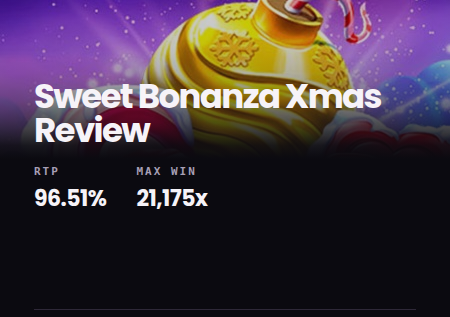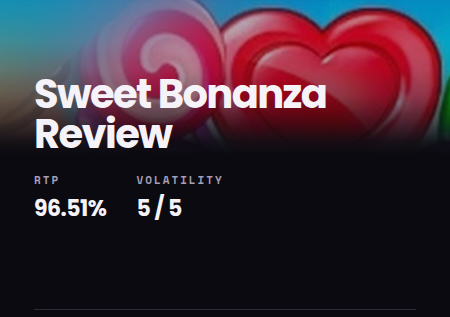

Sweet Bonanza is the biggest slot in the world by search volume and the one I found the most surprises in. Pragmatic Play does not publish one return figure for it. The game publishes two, and they are not the number you have been reading everywhere.
I also opened the intro screen, which is where the studio tells a player how the game behaves. On a slot famous for brutal dry spells and five figure wins, the badge says low volatility. I read it twice and then took a screenshot.
| What it is | The figure |
|---|---|
| Return to player | A range, not a number. The paytable states a maximum of 96.6% and a minimum of 96.49% |
| Volatility | Low, on the game’s own intro screen |
| Maximum win | Over 21,100x your bet, in the game’s own wording |
| Studio | Pragmatic Play |
| Grid | Six reels, five rows, symbols pay anywhere with no paylines |
| How a win forms | Eight or more matching symbols anywhere, then the winners tumble away |
| Multipliers | Up to 100x, and only inside the free spins |
| Bonus buy | 100x your bet, measured in the demo at €200 on a €2 stake |
| Double Chance | Raises the stake 25%, from €2.00 to €2.50, for a better scatter chance |
| Stake range | €0.20 to €300, as stated inside the game |
| Hit frequency | 50.00%, on Pragmatic Play’s own demo site |
| Free spins frequency | Not published |
| My score | 6 / 10 |
Every figure in this table I read inside the game itself, in the free demo on this site, on 20 October 2026.
Casinos on this site are scored on four published criteria and so are games. I score what the studio publishes, not how the game felt over twenty spins, and where nothing is published that a criterion can be built from I leave it unscored and say so.
| What I scored | Score | Why |
|---|---|---|
| Return to player | 8 / 10 | The guaranteed figure is the published minimum of 96.49 percent, which lands in the 96.20 to 96.49 band. The published maximum of 96.6 would have scored 9, and the game will not tell you which one you are playing |
| Cost of reaching the feature | 6 / 10 | The buy is 100 times the stake, the bottom of the 100x to 199x band. Twenty euros at the minimum stake, which a small balance can reach, though it is a hundred base spins for one feature |
| Volatility honesty | 4 / 10 | One of the three figures is published, the hit frequency at 50 percent, on the studio’s own demo site rather than in the game. It supports the low label on how often the game pays and says nothing about the 21,100x tail that works against it |
| Session survivability | Unscored | This band is built from the number of spins between features. Pragmatic publishes no such figure, so I will not invent one |
| Overall | 6 / 10 | Average of the three that could be scored, rounded |
Eight plus six plus four is eighteen, divided by three is exactly six. The bands behind each number are on my method page.
Six out of ten is the same score Gates of Olympus earned, and for almost the same reasons. Both are well built games with a fair return and an affordable buy, and both lose the same four points because most of the numbers that describe how they behave are not published. I scored volatility honesty at three when this review first went up, because I had looked only at the game and the corporate game page. On 21 October 2026 I found the hit frequency on pragmaticplay.fun, the studio’s own demo site, and raised that criterion to four. The overall score does not move: eight, six and four average to exactly six. You can read the whole method on the page where I set the rules out.
Every site that covers this game, including our own library listing, prints 96.51 percent as the return. Open the paytable and page to the fourth screen of seven. It says something different.
In two lines, one above the other, the game states that the maximum RTP of this game is 96.6 percent and the minimum RTP of this game is 96.49 percent. No single figure appears anywhere in the game. The number the whole internet quotes sits between the two and is published by neither.
The spread is small, eleven hundredths of a point, so this is not the Book of Dead problem where one name hides a twelve point gap. It matters for a different reason. A studio that prints a range is telling you the return moves with how you play, and it is not telling you which choice moves it.
I score the figure a player is guaranteed rather than the one they might get, so 96.49 percent is what I use. That lands one hundredth of a point below the band that starts at 96.50, which is an unlucky place to sit and an honest one to report.
Before your first spin, the intro screen shows a badge. On Sweet Bonanza it reads Low Volatility, in yellow, with the same icon Pragmatic uses across its catalog.
This is a slot that can go two hundred spins without a scatter and then pay four figures in one tumble sequence. Our own library record rates it four on a five point volatility scale. Every review you will read calls it high. The studio’s own badge says low.
I have now seen three of these badges on three Pragmatic games. Gates of Olympus says medium, Gates of Olympus 1000 says high, and Sweet Bonanza says low. The labels are set per game, so this is a deliberate classification rather than a default that slipped through.
I can test half of it. Pragmatic publishes a hit frequency for this game, 50 percent, on its own demo site, and that figure does back the low label: a paying spin every two spins is the highest hit rate of any game I have scored. What it does not touch is the other half of volatility, the size of the tail, and a 21,100x ceiling is a very long tail indeed. So the word is half earned and half unexamined, because the studio publishes no free spins frequency and no odds of reaching that ceiling.
| The figure | Published | Where |
|---|---|---|
| Return to player | As a range | Paytable page four, 96.49 to 96.6 percent |
| Maximum win | Yes | The intro screen, over 21,100x your bet |
| Volatility | As one word | The intro screen, Low |
| Bonus buy price | Yes | The buy button, 100x your bet |
| Stake range | Yes | Paytable page four, €0.20 to €300 |
| Hit frequency | Yes | 50 percent, on pragmaticplay.fun, the studio’s own demo site. Not inside the game |
| Free spins frequency | No | Nowhere I could find |
| Odds of the 21,100x win | No | Nowhere I could find |
Five of these eight are published, which is more than most slots manage. None of the three that would let you test the volatility claim is among them.
The buy button prices the free spins at one hundred times your stake. I measured it in the demo, where a two euro bet put two hundred euros on the button, and that is the same multiple Gates of Olympus charges.
What you buy is ten free spins with every multiplier bomb live. Those bombs carry values up to one hundred times, and they only appear inside the feature. In the base game the tumbles pay and nothing multiplies them, which is the whole reason the buy exists.
Double Chance is the other button and it works differently. It raises your stake by twenty five percent, from two euros to two euros fifty in my demo, and improves the chance of landing the four scatters that start the round. Pragmatic does not say by how much.
| How you spend €50 | What it buys | What is left |
|---|---|---|
| All base spins at €0.20 | 250 spins | Nothing, and no published frequency to tell you if that is enough |
| One buy at €20, rest in spins | 1 guaranteed feature plus 150 spins | €0 after the spins run out |
| Two buys at €20 each | 2 guaranteed features | €10, which is 50 more spins |
| All base spins with Double Chance at €0.25 | 200 spins at a better scatter chance | Fifty fewer spins for an unstated improvement |
The buy costs 100 times the stake, so at the twenty cent minimum one feature is twenty euros. At the two euro stake I used in the demo the same button asks for two hundred.
Here is the gap I keep running into on Pragmatic games. I cannot tell you whether 250 base spins usually reaches the feature once, because the studio does not publish how often it arrives. On Money Train 5 I could answer that in one line, because Relax Gaming prints the number.
While I was checking I compared the game against our library record for the same title, and three things did not match. I am reporting them here because the record is on this site and you may have read it.
| Figure | Our library record | The game itself |
|---|---|---|
| Return to player | 96.51 percent, a single number | 96.49 to 96.6 percent, a range |
| Maximum bet | €100 | €300 |
| Volatility | Rated 4, on a scale the feed does not explain | Low |
| Maximum win | 21,100x | Over 21,100x, which is the same figure worded as a floor |
Our library data comes from a third party feed covering tens of thousands of games. Where it disagrees with the game, the game wins, and this review uses the game.
None of this is sinister. A feed that carries 35,000 titles cannot read every paytable, and a single averaged return figure is easier to put in a column than a range. It is still worth knowing which of the two numbers in front of you was typed by the studio.
The game is the same everywhere. The terms wrapped around it are not, and that is where a session quietly gets more expensive. Four things are worth thirty seconds each.
First, the return printed in the game information panel, every time you open the game at a casino you have not used before. Plenty of slots ship in more than one build, and that panel is the only place the figure you are actually playing is shown.
Second, how the game counts toward wagering, and whether buying a feature voids an active bonus. Slots usually count in full, but feature purchases are excluded under most terms and some casinos cancel the bonus outright for one. The wagering terms are where both of those live.
Third, the maximum stake allowed while a bonus is running. It is commonly five euros a spin, and going over it once is enough for a casino to void everything the bonus produced.
Fourth, the cap on what you may withdraw from bonus winnings. A large maximum win means nothing if the terms stop your payout well below it, and that ceiling is printed in the bonus terms rather than in the game.
Because Pragmatic Play publishes a range rather than one figure, an hour of this game has two prices and you are never told which one you are paying. Six hundred spins in an hour is an ordinary pace once autoplay is running, so the gap compounds quickly.
| Stake per spin | Wagered in an hour | At the 96.6% end | At the 96.49% end |
|---|---|---|---|
| €0.20 | €120 | €4.08 | €4.21 |
| €0.50 | €300 | €10.20 | €10.53 |
| €1.00 | €600 | €20.40 | €21.06 |
The house keeps 3.40 percent at the top of the published range and 3.51 percent at the bottom. Six hundred spins an hour, the edge applied to everything wagered in that hour, averaged over a very long run rather than predicted for one session.
The demo runs on a play money balance that resets when you reload it, with no account and no deposit. Let the intro screens play through rather than clicking past them. Two of the figures in the table above appear there and nowhere else.
Twenty seven of the 36 casinos I have reviewed list Pragmatic Play among their suppliers, so this is one of the easiest games on the site to find. Seven of those reach seven out of ten, the highest score any casino holds here.
| Casino | Score | Terms fairness | Full review |
|---|---|---|---|
| Playfina Casino | 7 / 10 | 6 / 10 | Read the review |
| National Casino | 7 / 10 | 6 / 10 | Read the review |
| HellSpin Casino | 7 / 10 | 6 / 10 | Read the review |
| CasinoChan Casino | 7 / 10 | 5 / 10 | Read the review |
| SlotsGem Casino | 7 / 10 | 5 / 10 | Read the review |
| 22Casino | 7 / 10 | 4 / 10 | Read the review |
| Bizzo Casino | 6 / 10 | 4 / 10 | Read the review |
Seven of the twenty seven are shown here. Each casino score is the average of four criteria, and the full working is inside every review.
When several casinos tie I separate them the same way every time. First on terms fairness, because that clause set decides whether a win reaches you. Then on payouts and support, then on bonus value.
Three casinos tie at seven out of ten with terms fairness of six, and all three also score eight for payouts and support. Bonus value splits them, seven against six and five, and Playfina takes it. That is why the button below points there.
What is the RTP of Sweet Bonanza?
The game does not publish one number. Its paytable states a maximum of 96.6 percent and a minimum of 96.49 percent, and the 96.51 figure quoted across the internet appears nowhere inside the game. I score the minimum, because that is the only figure a player is guaranteed.
Is Sweet Bonanza high or low volatility?
The game’s own intro screen says low. That is the only volatility statement Pragmatic Play makes, and it contradicts how the game plays and how every review describes it. Our library feed rates it four out of five, so even the data on this site disagrees with the badge.
What is the maximum win on Sweet Bonanza?
The intro screen says you can win over 21,100 times your bet, and the wording is a floor rather than a ceiling. At the twenty cent minimum that is 4,220 euros. Pragmatic publishes no odds of reaching it, so the figure tells you the prize and not the price.
How much does the bonus buy cost?
One hundred times your stake. I measured it in the demo, where a two euro bet priced the buy at two hundred. At the twenty cent minimum one feature costs twenty euros, so fifty euros buys two of them with ten left over.
What does Double Chance actually do?
It raises your stake by twenty five percent, from two euros to two euros fifty in the demo, and improves your chance of landing the four scatters that trigger the free spins. Pragmatic does not publish by how much, so you are paying a known price for an unstated improvement.
Why do the multipliers only appear in free spins?
That is how the game is built. The bombs carrying values up to one hundred times land only inside the feature, and the base game tumbles pay without any multiplier. It is the single clearest reason the buy button exists and why base play feels flat.
How often do the free spins arrive?
Pragmatic publishes a hit frequency of 50 percent on its own demo site, so roughly every second spin returns something. It publishes no feature frequency, so how often the free spins round itself arrives is not something anyone outside the studio knows, and that is why one of my four scoring criteria is left unscored. If a site gives you a free spins frequency confidently, ask where they got it.
Is Sweet Bonanza 1000 the same game?
No, and this review covers the original only. The 1000 version raises the multiplier ceiling, which widens the swings for the same return rather than paying more over time. If you want the gentler of the two, the original is the one to open.
Can I play Sweet Bonanza for free?
Yes. The demo on this site runs the same certified game on a play money balance, with no account and no deposit. The buy button works in demo mode too, so you can see what a hundred times your stake buys before you ever pay for it.
Why did you score it six out of ten?
Eight for a return that is good but published as a range, six for a buy priced at a hundred times the stake, and three for disclosure. The fourth criterion could not be scored at all. The full working is on my method page.

I came to this from finance, which is probably why I read a casino the way I read a contract. The marketing sits on the homepage, and the clause that decides whether you get paid sits twelve pages down.
I am responsible for everything published here. Every figure on this page was read inside the game itself, in the demo on this site, on 20 October 2026, including the two return figures on the fourth paytable screen and the volatility badge on the intro. Where our own library listing disagrees with the game, I have said so rather than quietly picking one. If you find a figure that no longer holds, write to me.
18+. Gambling can be addictive. A return of 96.49 to 96.6 percent is a long run average across millions of spins and it describes no single session, including yours. Buying the feature does not improve that return, it only decides when you pay for it. If gambling has stopped being entertainment, free and confidential help is available in Slovenia through NIJZ.