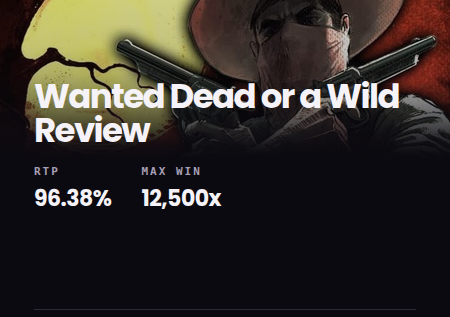

Hacksaw Gaming publishes four different returns for Wanted Dead or a Wild, 96.38, 94.55, 92.33 and 88.42 percent, and its own game page lists all four in one line without saying which is which. I score it 4 out of 10, and almost none of that is about the game itself. It is about the eight percentage points between the best build and the worst, and the fact that nothing on your screen tells you which one you just opened.
This is a western themed slot on a five by five grid with fifteen fixed paylines, released on 29 September 2021. It became one of the most played games Hacksaw has ever shipped, and that popularity is exactly why the build question matters. A game this widely placed gets placed by hundreds of operators, and each of them picks a version.
Everything below is arithmetic you can repeat yourself, built from figures the studio and its own data sheet publish. No casino has paid to appear here.
These are the published figures. Where the studio prints nothing, I have written that instead of filling the gap with a guess.
| Specification | Wanted Dead or a Wild |
|---|---|
| Studio | Hacksaw Gaming |
| Released | 29 September 2021 |
| Return to player | 96.38%, 94.55%, 92.33% or 88.42%, operator’s choice |
| Maximum win | 12,500x your bet |
| Odds of the maximum win | Not published |
| Volatility | 4 out of 5 on the studio’s own scale |
| Hit frequency | Not published by the studio |
| Bonus frequency | Not published |
| Grid | Five reels of five, 15 fixed paylines |
| Bonus games | The Great Train Robbery, Duel at Dawn, Dead Man’s Hand |
| Bonus buy | Yes, three prices, from 80x to 400x the bet |
| Minimum bet | €0.20 |
Return, maximum win, volatility, grid and the bonus list come from Hacksaw’s own game page. The release date and the buy prices come from the game data sheets that carry them, because the studio page prints neither.
Four criteria, each out of ten, averaged and rounded. The rating method is the same one I use everywhere on this site, and it scores what a game costs and what it discloses, not whether it is fun.
| Criterion | Score | Why |
|---|---|---|
| Return to player | 5 / 10 | The top build at 96.38 percent is genuinely good. The problem is that it is one of four, the lowest returns 88.42, and you cannot tell them apart from the outside |
| Cost of reaching the feature | 4 / 10 | The cheapest purchase is eighty times the bet. Studios that want you inside the feature price the first door far lower than that |
| Volatility honesty | 3 / 10 | No hit frequency, no bonus frequency, no odds on the 12,500x ceiling. The four returns are listed, which is better than hiding them, but with no label saying which market gets which |
| Session survivability | 5 / 10 | Twenty cents keeps the door open and fifteen fixed lines keep the bet honest, but a volatility of four out of five and no published bonus frequency means a small balance is a short visit |
| Overall | 4 / 10 | Average of the four, rounded |
Four out of ten is not a verdict on the game. It is a verdict on how much of its price you are allowed to see before you pay it.
For contrast, Duck Hunters scores 7 out of 10 on these same four criteria, and it is not a better game. It is a game whose studio publishes the hit frequency, the bonus frequency and the odds of the top prize.
Most studios ship one return and leave it alone. Hacksaw ships four builds of this game, and the casino picks the one it wants to run. The game looks identical either way. Same reels, same bonuses, same artwork, same name on the tile.
Here is what that choice costs you. I have used the same model as my cost per hour table, six hundred spins an hour at fifty cents, which pushes €300 across the table in an hour.
| Build | House edge | Cost of one hour | Spins €50 buys |
|---|---|---|---|
| 96.38% | 3.62% | €10.86 | 6,900 |
| 94.55% | 5.45% | €16.35 | 4,590 |
| 92.33% | 7.67% | €23.01 | 3,260 |
| 88.42% | 11.58% | €34.74 | 2,160 |
House edge is one hundred minus the return. The hourly cost is that edge applied to €300 of turnover. The last column is €50 divided by what one twenty cent spin costs you on average, so it is the number of spins the same fifty euros buys on each build.
The same fifty euros lasts a little over three times longer on the best build than on the worst. That is the whole point, and it is decided by somebody you will never speak to, before you ever open the game.
One more detail worth knowing. Game databases that track which builds actually appear in the wild list 94.55 percent as the version they see most often, not the 96.38 that every review quotes. Treat the headline figure as the best case rather than the normal one.
You can find it, but not from the lobby. Open the game, open the information or paytable panel, and look for the return figure printed there. That number is the build the casino has licensed, and it is the only place it appears.
If the panel prints nothing, that tells you something as well. A casino running the headline build has every reason to show it. One running 88.42 percent does not.
Do this once per casino rather than once per game. An operator that chooses a reduced build for this title has usually chosen reduced builds across its whole Hacksaw shelf.
Three bonuses, three prices. The studio also publishes a separate return for each purchase, which is more than most studios do, and those three figures sit within about one tenth of a percent of the base game.
| Buy | Price | At €0.20 | At €1.00 | Return when bought |
|---|---|---|---|---|
| The Great Train Robbery | 80x | €16 | €80 | 96.27% |
| Duel at Dawn | 200x | €40 | €200 | 96.33% |
| Dead Man’s Hand | 400x | €80 | €400 | 96.43% |
The buy returns are quoted against the 96.38 percent build. The studio does not say what a purchase returns on the 94.55, 92.33 or 88.42 builds, so on those the figures above do not apply and no published figure replaces them.
Note what that last line means in practice. If your casino runs a reduced build, the bonus buy numbers quoted in every review of this game, mine included, are not the numbers you are buying. Nobody publishes the ones you are.
The cheapest entry is eighty times your stake, so at the twenty cent minimum one purchase costs sixteen euros. That is the cheapest door into the feature, and it is already eighty spins of ordinary play.
The engine is called DuelReels. VS symbols land on the grid and expand into full wild reels, two gunmen face off, and whichever wins applies its multiplier to that entire reel. That is the moment the game is built around.
Three scatters open one of three bonus games, and which one you get depends on which scatter landed. The Great Train Robbery turns wilds sticky so they keep paying on later spins. Duel at Dawn raises the chance of several VS symbols arriving together, so up to five reels can turn wild at once.
Dead Man’s Hand runs in two halves. The first collects wilds and multipliers, the second is a showdown where everything collected is dropped onto random positions on every spin. It is the most expensive to buy and the one with the highest published return.
The ceiling is 12,500 times your bet. At the twenty cent minimum that is €2,500. The studio does not publish how often it happens, so unlike a handful of its competitors there is no honest way to price that ceiling, and I will not invent one.
First, the return in the game information panel, every time you open it at a new casino. It takes ten seconds and it is the difference between a 3.62 percent edge and an 11.58 percent one.
Second, whether bonus buys are switched on at all. Several markets ban them outright, so the eighty times entry simply will not be there, and the only way into the feature is to wait for it.
Third, how this game counts if you are clearing a bonus. Slots usually count in full, but a bonus buy is excluded under most terms, and buying one while a wagering requirement is open can void it. The wagering terms are where that clause lives.
The demo runs the studio’s default build, so it is the 96.38 percent version rather than whatever a casino has licensed. That makes it the right place to learn the three bonus games and the DuelReels mechanic without paying a reduced return to do it.
Open the information panel while you are in there. Reading where the return is printed in the demo is the same habit you will need at every casino that lists this game.
Every casino below was reviewed and scored before it appeared here. None of them publishes which Hacksaw build it runs, so check the panel yourself at whichever one you pick.
| Casino | Score | Full review |
|---|---|---|
| 22Casino | 7 / 10 | Read the review |
| National Casino | 7 / 10 | Read the review |
| HellSpin Casino | 7 / 10 | Read the review |
What is the RTP of Wanted Dead or a Wild?
There is no single answer. Hacksaw publishes four builds, 96.38, 94.55, 92.33 and 88.42 percent, and the casino picks one. The figure in the game information panel is the only one that applies to you.
Why does the same game have four different returns?
Studios ship multiple builds so operators can choose their own margin, and the game is identical to play on all of them. Hacksaw lists all four on its own page without saying which market receives which.
How do I find out which version my casino is running?
Open the game, then open the information or paytable panel and read the return printed there. It is the only place the figure appears, and the lobby tile never shows it.
What is the maximum win on Wanted Dead or a Wild?
Twelve thousand five hundred times your bet, which is 2,500 euros at the twenty cent minimum stake. The ceiling is the same on every build, but the return feeding it is not.
How often does the maximum win land?
Nobody knows, because the studio does not publish the odds. A handful of competitors do publish that figure for their own games, which is why this one loses points in my scoring.
What do the three bonus buys cost?
The Great Train Robbery costs eighty times your bet, Duel at Dawn two hundred, and Dead Man’s Hand four hundred. At the twenty cent minimum that is sixteen, forty and eighty euros.
Which bonus buy gives the best return?
On the 96.38 percent build, Dead Man’s Hand at 96.43 percent, just ahead of Duel at Dawn and the Train Robbery. On the reduced builds no purchase return is published at all.
Can I play Wanted Dead or a Wild for free?
Yes, the demo runs on this site with a play money balance and needs no account, no deposit and no email address. It uses the studio’s default build, not whatever a casino has licensed.
Is Wanted Dead or a Wild a high volatility slot?
The studio rates it four out of five, so wins arrive rarely and land large. It does not publish a hit frequency or a bonus frequency, so how rare is left unquantified.
Does a bonus buy count toward casino bonus wagering?
Usually not, and at many casinos buying a feature while a wagering requirement is open voids the bonus outright. Read that clause before you buy anything with bonus money.

I score slots on what they cost and what they tell you, which is why a game this well made ends up at four out of ten. Wanted Dead or a Wild is a genuinely good piece of design. It is also sold in four versions that play identically and price very differently.
Every figure on this page comes from the studio’s own game page or from the data sheets that publish the release date and the buy prices it leaves out. Where nothing is published, I have written that rather than borrowing a number from somewhere that invented it.
18+. Gambling can be addictive. At four out of five on the studio’s own volatility scale, long runs without a win are the normal behaviour of this game rather than bad luck. The published return describes millions of spins, not your session. If gambling stops being entertainment, stop and seek help.