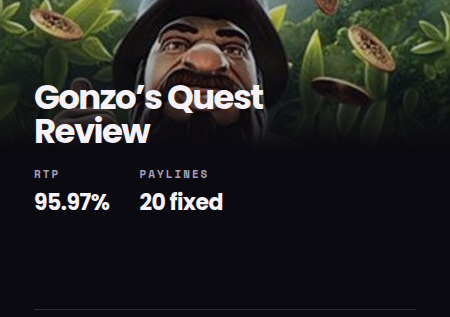

The Gonzo’s Quest RTP is 95.97 percent, and NetEnt publishes where it goes: roughly 65 percent through the base game and 30 percent through Free Falls.
Gonzo’s Quest returns 95.97 percent, and the studio publishes where that return goes: about 65 percent through the base game and about 30 percent through the Free Falls bonus. If you never trigger the bonus, you are playing a sixty five percent game. I score it 7 out of 10.
This is a NetEnt slot from 2011, now under Evolution, on five reels and three rows with 20 fixed paylines. Nothing spins. Blocks fall into the grid, winners crumble away, new blocks drop into the gap, and each consecutive win raises a multiplier. That mechanic was called the Avalanche and it is the reason half the industry now uses falling symbols.
What makes this page different from my other slot reviews is how much of its own math this game publishes. You get hit frequencies, a split of the return, and the exact probability of each multiplier level. Almost no classic slot gives you that, and it is why this one scores where it does.
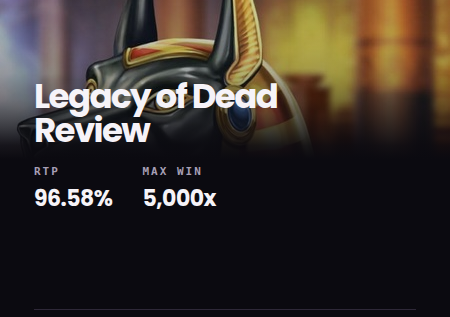
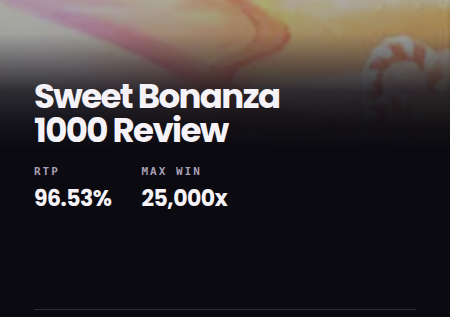
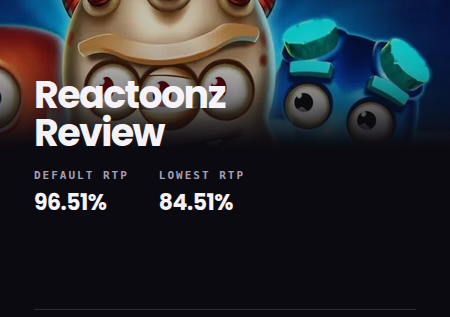
One note on the name before the figures. The game is written Gonzo’s Quest, and you will meet it just as often as Gonzos Quest or plain Gonzo Quest. All three spellings point at this slot and at the same 95.97 percent. Gonzo’s Gold and Gonzo’s Quest 2 are separate games with their own returns, and both sit in the comparison further down.
Evolution keeps a live page for this game and most of what follows comes from it. The rows that go beyond the studio page are marked, because the distinction matters when you are deciding how much to trust a number.
| What it is | The figure |
|---|---|
| Return to player | 95.97%, on the studio page, which is a house edge of 4.03 percent |
| Return from the base game | 65.3%, published beyond the studio page |
| Return from Free Falls | 30.4%, published beyond the studio page |
| Studio and year | NetEnt, now part of Evolution, released 2011 on the studio page, though databases print 2010 and 2013 |
| Grid | Five reels, three rows, 20 fixed paylines, with falling blocks instead of spinning reels |
| Stake range | 0.20 to 50 a spin |
| Maximum win | 2,500x on the studio page, which becomes 12,500x with the base multiplier and 37,500x in Free Falls |
| Hit frequency, base game | 41.1%, about one paying spin in 2.4 |
| Hit frequency, Free Falls | 54.4%, about one paying spin in 1.8 |
| Volatility | Mid on one line of the studio page and Medium to High on another |
| Free Falls frequency | Not published |
| Bonus buy | None on the original game |
How to read this. Count the rows marked as published. This game gives you two hit frequencies and a breakdown of where its return comes from. Thunderstruck II, reviewed on this site, publishes none of that, and the difference between a 4 and a 7 on my scoring is almost entirely this table.
Casinos on this site are scored on four published criteria and so are games, on four of their own. Each is marked out of ten and the average is rounded to a whole number, with a half rounding up. Where a studio publishes nothing a criterion can be built from, I leave it unscored and average the rest. The bands are published in my scoring method.
| Criterion | Score | Why |
|---|---|---|
| Return to player | 6 / 10 | 95.97 percent sits just under the ninety six line the industry used as its default. Honest, and a little below fair |
| Cost of reaching the feature | 10 / 10 | No bonus buy and no level that unlocks on a counter. Three scatters on the first three reels is the whole requirement, from your first spin |
| Volatility honesty | 5 / 10 | Hit frequency is published for both modes and every multiplier level carries a probability. The odds of the maximum win are absent and the Free Falls trigger rate is not published |
| Session survivability | Not scored | The band needs a published bonus frequency. It is the one number this game withholds |
| Overall | 7 / 10 | Average of the three that could be scored, rounded |
How to read this. Six, ten and five make twenty one. Divided by three that is exactly seven. The parts are printed so you can redo it.
Seven is the joint highest score I have given a game, and it is worth being precise about what earned it. Not the return, which is the weakest of the four classics I have scored. Not the design, though the Avalanche deserves its reputation.
What earned it is that NetEnt published the probability of every multiplier level and the hit frequency of both game modes, on a slot from 2011. That is more than most studios publish on games released this year, and it lets a player work out what the game is actually doing instead of taking it on faith.
Almost every page about this game quotes 95.97 percent and stops. The more useful figure sits one level down, and it is published: 65.3 percent of the return comes from the base game and 30.4 percent comes from Free Falls. Those two add to 95.7, which is the headline figure within rounding.
Read that again with your own session in mind. Just under a third of everything this game pays back is locked inside a bonus round. The reels you watch for most of your time are returning about sixty five cents on the euro, and the missing thirty cents only arrives if and when the Free Falls land.
| Where the return comes from | Share | What it means for a session |
|---|---|---|
| Base game | 65.3% | What you get if the bonus never triggers |
| Free Falls | 30.4% | Held back until three scatters land on the first three reels |
| Published total | 95.7% | Within rounding of the 95.97 the studio prints |
How to read this. This is not a flaw and it is not unusual. Most modern slots concentrate their return in the bonus. What is unusual is that the split is published at all, so you can see the shape of the game instead of guessing at it.
The practical consequence is simple. A short session on this game is a sixty five percent session, and the return only climbs toward the advertised figure over enough spins for the bonus to arrive repeatedly. That is the honest answer to why a 95.97 percent slot can feel so much worse than one.
Free Falls is the name of the bonus, and it opens when three Free Fall scatters stop on the first three reels, with wilds able to stand in for them. Ten free spins follow, further scatters inside the round extend it, and the ladder below is the reason the round is worth reaching at all.
Each consecutive win in the same spin raises the multiplier. In the base game it runs 1x, 2x, 3x and then 5x. In Free Falls it runs 3x, 6x, 9x and then 15x. What almost nobody prints is how often you reach each level, and that is published too.
| Avalanche | Base game multiplier | Chance | Free Falls multiplier | Chance |
|---|---|---|---|---|
| First | 1x | 12.5% | 3x | 25.2% |
| Second | 2x | 3.1% | 6x | 11.5% |
| Third | 3x | 0.5% | 9x | 4.7% |
| Fourth or more | 5x | 0.03% | 15x | 1.7% |
How to read this. The bottom left cell is the one to sit with. A 0.03 percent chance is roughly one spin in 3,300, so the famous 5x multiplier in the base game turns up about once in every 3,300 spins. In Free Falls the 15x arrives at 1.7 percent, which is roughly one free spin in 59, and that is the entire reason the bonus carries a third of the return.
Search this game and you will find three different maximum win figures. The studio says 2,500x. Databases print 12,500x and 37,500x. Those are not contradictions, and the explanation takes one line.
The 2,500x is the ceiling on a single line win before any multiplier. Apply the base game maximum of 5x and you get 12,500x. Apply the Free Falls maximum of 15x and you get 37,500x. Every one of the three numbers is correct about a different moment in the game.
| Which figure | How it is reached | At 0.20 a spin | At 2.00 a spin |
|---|---|---|---|
| 2,500x | A maximum line win with no multiplier | 500 | 5,000 |
| 12,500x | The same win with the 5x base multiplier | 2,500 | 25,000 |
| 37,500x | The same win with the 15x Free Falls multiplier | 7,500 | 75,000 |
How to read this. The 37,500x is the real ceiling of this game and reaching it needs a maximum line win landing on a fourth consecutive avalanche inside the bonus. Nobody publishes the odds of that combination, which is the one disclosure gap that matters here.
At the 20 cent minimum, fifty euros buys 250 spins. Over that turnover the expected loss at 95.97 percent is about two euros, which sounds painless and is, in the long run sense that the figure describes.
The session you actually get is a different animal, and now you can calculate why. The base game returns 65.3 percent. If the Free Falls never land in those 250 spins, the math describing your evening is not 95.97 but something close to 65, and that gap is the difference between a slot that feels fair and one that feels broken.
| What happens in 250 spins | Expected return | What it feels like |
|---|---|---|
| Free Falls never trigger | About 65% | The game has taken a third of your balance and shown you nothing |
| Free Falls trigger once or twice | Closer to the headline | A normal session with one good moment |
| Free Falls trigger with deep avalanches | Well above the headline | The session people post about |
| Over millions of spins | 95.97% | The only figure the studio is actually promising |
How to read this. The studio does not publish how often Free Falls lands, so I cannot tell you which row you are most likely to get. That single missing number is why this review leaves one of its four criteria unscored, even though the game publishes more math than any other classic I have looked at.
I have now scored four classics on this site and they land three points apart. The games are all roughly the same age and all still earning. What separates them is how much each studio is willing to print.
| Game | Return | Hit frequency published | Multiplier odds published | Score |
|---|---|---|---|---|
| Gonzo’s Quest | 95.97% | Yes, both modes | Yes, every level | 7 / 10 |
| Starburst | 96.09% | Yes, not from the studio | No feature levels exist | 7 / 10 |
| Mega Moolah | 93.42% | No | No | 5 / 10 |
| Thunderstruck II | 96.65% | No | No | 4 / 10 |
How to read this. Look at the first and last rows together. Thunderstruck II has the better return by almost 0.7 of a percentage point and scores three lower, because you cannot check a single thing about it beyond that one number. A good return you cannot verify is worth less than a slightly weaker one you can.
That is the argument this whole site is built on, and Gonzo’s Quest is the clearest demonstration of it I have found. Nothing about the game design earns the extra points. The disclosure does.
Five Gonzo titles sit in our library and they are not variations on a theme. The grids, the returns and the ceilings all move, and one of them is sold at two different returns.
| Game | Year | Return | Maximum win | Free demo |
|---|---|---|---|---|
| Gonzo’s Quest | 2011 | 95.97% | 37,500x with the bonus multiplier | Play it free |
| Gonzo’s Quest Megaways | 2020 | 94.66% or 96.00%, both on the studio page | 20,000x | Play it free |
| Gonzo’s Gold | 2021 | 96.11% | 3,484x | Play it free |
| Gonzo’s Quest 2 | 2025 | 96.06% | 15,825x | Play it free |
| Gonzo’s Quest Tap-a-Roo | Not recorded | Not published | Not published | Play it free |
How to read this. The Megaways row is the one to read twice. Red Tiger prints both 94.66 and 96.00 percent on its own page for that game and does not say which applies to you. That is a gap of 1.34 percentage points decided by your casino, not by you, and it is the same practice I found on Starburst.
If somebody told you Gonzo’s Quest was a gentle game and you opened the Megaways version, you did not get more of the same. You got a high volatility slot on a six reel grid with up to 117,649 ways, a lower ceiling than the original once its bonus multiplier is counted, and a return that may be 94.66 or 96.00 depending on where you opened it. Read the figure inside whichever one you play.
The game is the same everywhere. The terms wrapped around it are not, and that is where a session quietly gets more expensive. Four things are worth thirty seconds each.
First, the return printed in the game information panel, every time you open the game at a casino you have not used before. Plenty of slots ship in more than one build, and that panel is the only place the figure you are actually playing is shown.
Second, how the game counts toward wagering, and whether buying a feature voids an active bonus. Slots usually count in full, but feature purchases are excluded under most terms and some casinos cancel the bonus outright for one. The wagering terms are where both of those live.
Third, the maximum stake allowed while a bonus is running. It is commonly five euros a spin, and going over it once is enough for a casino to void everything the bonus produced.
Fourth, the cap on what you may withdraw from bonus winnings. A large maximum win means nothing if the terms stop your payout well below it, and that ceiling is printed in the bonus terms rather than in the game.
The return figure on its own tells you nothing about what a session costs. What costs you money is the return multiplied by how much you push across the table, and a slot pushes a great deal. Six hundred spins in an hour is an ordinary pace once autoplay is running.
At 95.97 percent the house keeps 4.03 percent of everything staked. Here is what that is worth at three ordinary stakes, using the same model as my cost per hour table.
| Stake per spin | Wagered in an hour | House edge | Cost of the hour |
|---|---|---|---|
| €0.20 | €120 | 4.03% | €4.84 |
| €0.50 | €300 | 4.03% | €12.09 |
| €1.00 | €600 | 4.03% | €24.18 |
Six hundred spins an hour, the house edge applied to everything wagered in that hour. These are averages over a very long run, not a prediction for one session, and the swings in either direction are far larger than the edge.
The demo runs on a play money balance with no account and no deposit, and it resets when you reload. Give it twenty minutes rather than five, because the thing worth feeling here is how long the base game runs between bonuses.
Twenty six of the 36 casinos I have reviewed record NetEnt in the supplier list I pulled from their lobby, so this game is easy to find. Six of those reach seven out of ten, which is the highest score any casino holds on this site.
| Casino | Score | Full review |
|---|---|---|
| National Casino | 7 / 10 | Read the review |
| Playfina Casino | 7 / 10 | Read the review |
| HellSpin Casino | 7 / 10 | Read the review |
| 20bet Casino | 7 / 10 | Read the review |
| CasinoChan Casino | 7 / 10 | Read the review |
| Asino Casino | 7 / 10 | Read the review |
How to read this. The game is identical at all six. What is not identical is which return version each has switched on, and on the Megaways sequel that difference is 1.34 percentage points. Open the paytable and read the figure before your first real spin.
Playfina takes the link below on the tiebreak I use everywhere, the highest mark for terms fairness first, then payouts, then bonus value. The other twenty casinos carrying NetEnt score between four and six, and the full list shows where each one loses its points.
What is the RTP of Gonzo’s Quest?
95.97 percent on Evolution’s own game page, which is a house edge of 4.03 percent. More usefully, the return is published in two parts: about 65.3 percent comes from the base game and about 30.4 percent from the Free Falls bonus. Those two add to the headline within rounding.
Why does Gonzo’s Quest feel worse than 95.97 percent?
Because almost a third of the return is locked inside Free Falls. The reels you watch for most of a session return around 65 percent on their own. If the bonus does not land, the math describing your evening is closer to 65 than to 96, and that is arithmetic rather than bad luck.
How do you trigger Free Falls?
Land three Free Fall scatter symbols on reels one, two and three. Wilds can substitute for scatters. The trigger awards 10 free spins, and scatters landing during the bonus add more. Nobody publishes how often the trigger lands, which is the one figure this game withholds.
What is the maximum win on Gonzo’s Quest?
The studio prints 2,500 times your stake, which is the ceiling on a line win before any multiplier. Apply the 5x base game multiplier and it becomes 12,500x, and apply the 15x Free Falls multiplier and it becomes 37,500x. All three figures you will see quoted are correct about different moments in the game.
How often does the 5x multiplier land?
In the base game, 0.03 percent of the time, which is roughly one spin in 3,300. Inside Free Falls the equivalent top level is 15x and it lands 1.7 percent of the time, or about one free spin in 59. NetEnt publishes the probability of every level, which almost no studio does.
Can I play Gonzo’s Quest for free?
Yes, on a play money balance with no account and no deposit. The demo runs the same build as the real money game and the balance resets when you reload. You will find it on our Gonzo’s Quest demo page, along with the rest of the family.
Is Gonzo’s Quest Megaways the same game?
No. It runs on six reels with up to 117,649 ways, carries high volatility against the original’s medium, and Red Tiger prints two different returns for it on the studio page, 94.66 and 96.00 percent, without saying which one you get. The casino decides that, not you.
Why does this review score Gonzo’s Quest 7 out of 10?
Three criteria could be scored and one could not. The return earns six, the complete absence of gates or purchases earns ten, and the disclosure earns five because the hit frequencies and multiplier odds are published. Twenty one divided by three is exactly seven under my scoring method.
Which casinos have Gonzo’s Quest?
Twenty six of the 36 casinos I have scored record NetEnt in the supplier list taken from their lobbies. Six of those reach seven out of ten: National Casino, Playfina, HellSpin, 20bet, CasinoChan and Asino. The remaining twenty score between four and six.
Is Gonzo’s Quest good for a small balance?
Better than most, with one caveat worth taking seriously. The base game pays something on 41.1 percent of spins, so a twenty cent stake keeps a fifty euro balance alive for 250 spins with regular small returns. The caveat is that the real money is in a bonus whose trigger rate nobody publishes.

I came to this from finance, so a slot review that tells me a game is atmospheric tells me nothing. What I want is every published number in one place, converted into euros and into spins, with the missing ones named rather than guessed at.
The return, the grid, the paylines, the stake range and the multiplier levels on this page come from Evolution’s own game page. The hit frequencies, the split of the return and the probability of each multiplier level are published beyond it, and I have marked which is which. I am responsible for everything here. If a number no longer holds, write to me and I will check it.
18+. Gambling can be addictive. The demo linked on this page is played with play money that has no cash value and cannot be withdrawn. Return to player describes millions of spins and predicts nothing about a single session. No slot can be beaten with strategy, and the result of every spin is independent of the one before it. If gambling has stopped being entertainment, free and confidential help is available in Slovenia through NIJZ.