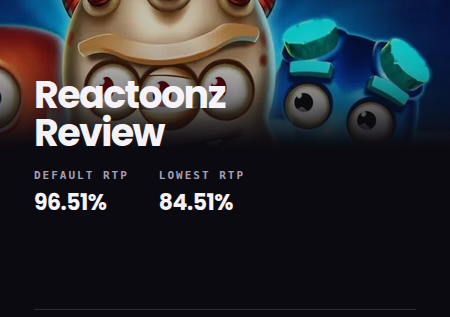

Reactoonz publishes no RTP in the game and none on Play’n GO’s page, while databases list five builds from 96.51 percent down to 84.51. Scored 5 of 10.
Reactoonz does not tell you what it returns. Not on the loading screen, not on the five information pages, not in the full rules text, and not on Play’n GO’s own page for the game. I score it 5 out of 10, and the silence is most of the reason.
This is a Play’n GO grid slot from October 2017, played on a seven by seven field. Aliens drop in, five or more touching each other pay, winners vanish, and new symbols fall into the gaps. There are no reels and no paylines.
I opened the demo on this site on 22 October 2026 and read every screen it has. What follows separates what the game told me from what it refused to.
The right hand column is the important one. Half of this table comes from the game and the studio, and half of it comes from databases because there was nowhere else to get it.
| Figure | What it says | Where I read it |
|---|---|---|
| Return to player | 96.51% on the default build | Two independent databases, nowhere official |
| Lower builds in circulation | 94.51%, 91.49%, 87.50% and 84.51% | Both databases list the same four |
| Volatility | High | Same two databases, no badge in the game |
| Maximum win | 4,570x or 4,750x, the two databases disagree | Databases only, nothing in the game |
| Stake range | 0.20 minimum, 100.00 maximum | Measured in the game by clicking the dial to both stops |
| Grid | Seven by seven, cluster wins of five or more touching symbols | Rules screen and the studio page |
| Top paytable value | 750x the bet for fifteen or more of the best symbol | Symbols page of the rules |
| Bonus buy | None, and no ante bet either | The game interface |
| Released | 23 October 2017 | Play’n GO’s own game page |
| Hit frequency | Not published anywhere | Checked the game, the studio page and both databases |
| How often the Gargantoon lands | Not published anywhere | Same three places |
| Odds of the 4,570x ceiling | Not published anywhere | Same three places |
The rows that say not published are the ones that would tell you how this game actually behaves, and that is as thin a disclosure as this method ever has to work with. It happens on a game that sells itself on one enormous feature.
I score a slot on four criteria. Where a studio publishes nothing a criterion can be built from, I leave that criterion unscored, say so here, and average the ones that remain.
| Criterion | Score | Why |
|---|---|---|
| Return to player | 9 | 96.51 percent sits at the bottom of the 96.50 to 96.99 band. The band measures the return, not who was willing to print it, and two independent databases give the same figure to two decimals |
| Cost of reaching the feature | 6 | There is no buy button and no ante bet, so this is scored on the trigger ladder. The headline feature needs the charge meter filled five separate times, which lands in the five to six band |
| Volatility honesty | 1 | The bottom of the scale. None of the three figures is published, the game carries no volatility badge, and the studio does not even advertise a maximum win to be sceptical about |
| Session survivability | Not scored | The band needs a published feature frequency. There is none, so I will not invent a spin count and present it as measurement |
| Overall | 5 / 10 | Nine, six and one, averaged and rounded |
The full method, with every band written out, sits on the rating method page. A five here means a genuinely good return bolted to a game that will tell you nothing about how it behaves.
Here is exactly where I looked. The game has an information button that opens five illustrated pages, covering the Gargantoon, the Quantum Leap meter, the four Quantum features, Giantoonz and Fluctuation, and the full paytable. No return figure on any of them.
Behind the help icon sits a second, much longer document, the plain text rules. It runs to unfinished games, malfunction clauses, cluster scoring, every feature in writing and every button on the interface. It does not contain the letters RTP.
The settings menu holds four switches for sound and spin speed. Play’n GO’s own page for the game gives you a release date, the words grid slot, and a sentence about aliens landing on a seven by seven grid.
| Where I looked | What it gave me |
|---|---|
| The five information pages in the game | No return figure |
| The full rules document behind the help icon | No return figure |
| The settings menu | No return figure |
| Play’n GO’s game page | No return figure |
| Two independent databases | 96.51%, both of them, to two decimals |
| The same two, on the lower builds | Four more returns: 94.51%, 91.49%, 87.50% and 84.51% |
Both databases also list the stake range as 0.20 to 100.00, which is exactly what I measured inside the game. That agreement is the reason I am willing to use their return figure.
Why that matters practically. 96.51 percent is a good number, better than most of what sits beside it in a lobby. You simply cannot confirm it from the game you are playing, and the game is the only place a casino’s actual build announces itself.
It gets worse than silence. Reactoonz is not sold at one return either. Both databases list five builds under this single name: 96.51 percent, then 94.51, 91.49, 87.50 and 84.51. Between the best and the worst sits almost twelve percentage points.
Play’n GO does exactly the same thing with Book of Dead, which ships at five returns from 96.21 percent down to 84.18. The difference is that Book of Dead prints its figure on the screen, so you can at least read which build you were handed. Reactoonz prints nothing, so you cannot.
So treat the 96.51 as the best case rather than a promise. If a casino ever does show you a number on this game, read it and trust it over this page.
Ask two databases what this game pays at its best and you get two answers. One says 4,570 times your stake, the other says 4,750. Neither can be called wrong, because there is no official figure for either of them to be wrong against.
The game itself never mentions a ceiling at all. There is no cap clause in the rules, no maximum win on the loading screen, and nothing on the studio page. At the 0.20 minimum those two figures come to 914 euros and 950 euros.
| Game | Ceiling | Who published it | Odds of reaching it |
|---|---|---|---|
| Reactoonz | 4,570x or 4,750x | Nobody official | Not published |
| Big Bass Splash | 5,000x | The game’s own rules | Not published |
| Duck Hunters | 30,000x | The studio | 1 in 22 million, published |
Three rows, three levels of disclosure. One studio publishes the probability attached to its own headline number, one publishes the number, and one publishes neither.
There is one figure the game does publish, and it is worth holding next to the 4,570x. The best symbol on the paytable pays 750 times your bet when fifteen or more of them land in one cluster.
That tells you the ceiling cannot come from a single cluster. It has to come from a chain, with the Gargantoon splitting into wilds and a cascade feeding the next win, and nobody will tell you how often that chain runs long enough.
This is the part the game explains properly, and it deserves credit for that. The mechanics are written out in full, in two places, with no marketing language around them.
Five charge meters sit beside the grid. Every time you win on twenty five symbols inside a round, one meter fills and a Quantum feature joins a queue. The feature chosen is random.
| Charge | What it adds to the queue |
|---|---|
| First | One of the four Quantum features, picked at random |
| Second | Another, and the queue now holds two |
| Third | Another, three in the queue |
| Fourth | Another, and four is the maximum the queue holds |
| Fifth | The Gargantoon, the only feature the game is remembered for |
Read from the Quantum Leap page of the rules. The queue fires when no winning combinations are left on the grid, and the round ends only when the queue is empty and nothing more is paying.
The four Quantum features are each described in one line, and each one is a way of manufacturing a win out of a dead grid.
| Feature | What it does |
|---|---|
| Implosion | Turns three to six symbols into wilds and destroys everything next to them |
| Incision | Puts a wild in the centre and draws two diagonals across the grid, both showing the same random symbol |
| Demolition | Destroys every one eyed symbol of one type and all matching symbols |
| Alteration | Picks one one eyed symbol type and turns every one of them into something else |
All four are written out on the Quantum Features page. What the game never says is how often each one is picked, so the queue is four unknown draws from a bag of four.
The Gargantoon itself is a three by three wild that substitutes for everything. It does not sit still. After the first cascade it splits into two two by two wilds, and after the next it splits again into nine single wilds, with fresh symbols dropping in before each move.
That is three waves of wilds from one feature, which is why a single Gargantoon can run a chain long enough to reach a number like 4,570x. It is also why a round with no Gargantoon usually ends quietly.
There is a second route to it, and the game is honest that it exists while saying nothing about its odds. On any opening spin that pays nothing, there is a chance the Gargantoon simply drops four to eight wilds onto the grid. That is called Instability, and a chance with no number attached is not information you can plan around.
One line in the rules is easy to skim and changes how you should read the whole game. Wild symbols cannot appear on their own. They exist only as a product of Fluctuation or of the Quantum features.
Fluctuation runs every spin. The game marks one of the one eyed symbol types as fluctuating, and if any marked symbol takes part in a win, it leaves two wilds behind when it vanishes.
So the sequence is strict. You need a win to get wilds, you need wilds to keep the cascade alive, and you need the cascade alive to charge the meters. A dead opening spin gives you nothing except the unquantified chance of Instability.
| Where a wild can come from | What has to happen first |
|---|---|
| Fluctuation | The marked symbol type has to be part of a win |
| Implosion or Incision | A charge meter has to fill, which needs a win on 25 symbols |
| The Gargantoon | Five charges, or the unpublished Instability chance |
| A plain spin | Never. Wilds do not sit on the grid by themselves |
Giantoonz are the other thing to know. Four matching symbols in a square block fuse into one oversized symbol, and any win they are part of pays double.
Put the doubling together with the cluster scale and the design becomes clear. On the paytable, which is printed at a one euro bet, five touching symbols of the cheapest kind pay 0.10. Fifteen or more of the best kind pay 750. Almost everything in this game is built to turn the first number into the second through cascades rather than through a bonus round.
Nothing in the interface sells you a shortcut. No buy button, no ante bet, no side wager that raises your chance of the Gargantoon. In a 2026 lobby that is becoming unusual, and it is worth saying out loud.
My method scores this on the trigger ladder instead of on a price. The question it asks is how far the good part of the game sits from your first spin, and here the answer is five charges of the meter.
| Game | How you reach the headline feature | Score |
|---|---|---|
| Big Bass Bonanza | One scatter trigger opens every level | 10 |
| Reactoonz | Five separate charges of the Quantum meter | 6 |
| Big Bass Splash | Pay 100x the bet, or wait | 6 |
| Immortal Romance | No buy, and the best room sits fifteen triggers deep | 3 |
A missing buy button is not automatically a kindness. What the band measures is distance, whether that distance is priced in money or in patience.
In practice the honest summary is that Reactoonz sits in the middle. You are never asked to pay a hundred spins for a feature, and you are never told how long the waiting usually runs either.
The stake dial stops at 0.20 going down and at 100.00 going up. I checked both ends by holding the control until it stopped moving, because the game does not print the range anywhere.
| What fifty euros is | At the 0.20 minimum |
|---|---|
| Ordinary spins | 250 spins |
| Expected cost of that turnover at 96.51 percent | About 1.75 euros |
| Spins that return something | Nobody publishes a hit frequency |
| Spins that reach a Gargantoon | Nobody publishes that either |
| The circulating ceiling, in money | 914 or 950 euros |
My arithmetic from the figures above, not the studio’s. Two of the five rows cannot be filled in, and those two are the rows that would tell you what an evening on this game actually feels like.
That 1.75 euro figure deserves a warning label. It is what the maths says a fifty euro turnover costs on average across millions of spins, and it is not what your session will cost. A high volatility grid game can take fifty euros in an hour and hand somebody else nine hundred.
The missing middle rows are the whole reason this game scores a five rather than a seven. I can tell you what it returns and what a session costs on paper. I cannot tell you how often anything happens.
The game is the same everywhere. The terms wrapped around it are not, and that is where a session quietly gets more expensive. Four things are worth thirty seconds each.
First, the return printed in the game information panel, every time you open the game at a casino you have not used before. Plenty of slots ship in more than one build, and that panel is the only place the figure you are actually playing is shown.
Second, how the game counts toward wagering, and whether buying a feature voids an active bonus. Slots usually count in full, but feature purchases are excluded under most terms and some casinos cancel the bonus outright for one. The wagering terms are where both of those live.
Third, the maximum stake allowed while a bonus is running. It is commonly five euros a spin, and going over it once is enough for a casino to void everything the bonus produced.
Fourth, the cap on what you may withdraw from bonus winnings. A large maximum win means nothing if the terms stop your payout well below it, and that ceiling is printed in the bonus terms rather than in the game.
The return figure on its own tells you nothing about what a session costs. What costs you money is the return multiplied by how much you push across the table, and a slot pushes a great deal. Six hundred spins in an hour is an ordinary pace once autoplay is running.
At 96.51 percent the house keeps 3.49 percent of everything staked. Here is what that is worth at three ordinary stakes, using the same model as my cost per hour table.
| Stake per spin | Wagered in an hour | House edge | Cost of the hour |
|---|---|---|---|
| €0.20 | €120 | 3.49% | €4.19 |
| €0.50 | €300 | 3.49% | €10.47 |
| €1.00 | €600 | 3.49% | €20.94 |
Six hundred spins an hour, the house edge applied to everything wagered in that hour. These are averages over a very long run, not a prediction for one session, and the swings in either direction are far larger than the edge.
The demo on this site runs the same build as the real money game, on play money that resets when you reload. No account and no deposit. It is where every figure above was read, and it is where you can confirm that the return really is missing.
If you want the same studio with its figures on display instead, the Book of Dead review covers a Play’n GO game that publishes five different returns, and explains how to tell which one your casino installed.
Twenty five of the 36 casinos I have reviewed record Play’n GO in the supplier list I pulled from their lobby, so this game is not hard to find. Seven of those twenty five reach seven out of ten, the highest score any casino holds on this site.
| Casino | Score | Game selection | Terms fairness | Full review |
|---|---|---|---|---|
| Playfina Casino | 7 / 10 | 8 / 10 | 6 / 10 | Read the review |
| National Casino | 7 / 10 | 9 / 10 | 6 / 10 | Read the review |
| HellSpin Casino | 7 / 10 | 9 / 10 | 6 / 10 | Read the review |
| 20bet Casino | 7 / 10 | 10 / 10 | 6 / 10 | Read the review |
| CasinoChan | 7 / 10 | 9 / 10 | 5 / 10 | Read the review |
Five of the seven are shown. Each score is the average of four criteria, rounded, and every one of them rounds to seven, so the decision has to be made below the rounding.
Playfina takes it, and only just. Playfina and National are the only two sitting at 7.25 before rounding, they match on terms fairness at six and on payouts at eight, and bonus value separates them at seven against six.
One habit to carry in, and on this game it matters more than usual. Open the rules before your first spin and look for a return figure. If one has appeared, read it and trust it over this page. If none has, you are playing the same blind build I was.
What is the RTP of Reactoonz?
Two independent databases give 96.51 percent as the default, and both also list four lower builds at 94.51, 91.49, 87.50 and 84.51 percent. Neither the game nor the studio publishes any figure, so you cannot tell which of the five your casino installed.
Why does the game not show its own RTP?
Play’n GO does not print one on this title, and no rule forces it to in most markets. I checked the five information pages, the full rules document, the settings menu and the studio’s own game page.
What is the maximum win in Reactoonz?
The two databases disagree, listing either 4,570 or 4,750 times your bet, which is 914 or 950 euros at the 0.20 minimum. The game carries no cap clause and no maximum win screen, so neither figure has official backing.
How do you trigger the Gargantoon?
Fill the Quantum Leap charge meter five times inside one round, which takes five separate wins on twenty five symbols. There is also a random chance of it dropping four to eight wilds after a non-winning opening spin.
What are the four Quantum features?
Implosion turns three to six symbols into wilds and destroys their neighbours, Incision draws two diagonals of one random symbol, Demolition destroys one one eyed symbol type, and Alteration converts one type into another.
Is there a bonus buy in Reactoonz?
No, and there is no ante bet either. Nothing in the interface lets you pay for a shortcut to the Gargantoon, which is becoming unusual for a game of this age still sitting in modern lobbies.
What is the minimum bet in Reactoonz?
0.20, and the maximum is 100.00. The game prints neither figure, so I measured both by holding the stake control down until it stopped and then up until it stopped.
Where do the wild symbols come from?
Only from Fluctuation and from the Quantum features. A plain spin never places a wild on the grid, which is why a round that opens without a win has almost nothing to build on.
What are Giantoonz?
Four matching ordinary symbols sitting in a square block fuse into one oversized symbol. Any winning combination a Giantoon takes part in pays double, and the rules state that plainly.
Why does this game score 5 out of 10?
The return earns nine and the five charge route to the feature earns six. Volatility honesty scores the minimum of one, because none of the three disclosure figures exists, and session survivability cannot be scored at all.

I came to this from finance, which is probably why I read a casino the way I read a contract. The marketing sits on the homepage, and the clause that decides whether you get paid sits twelve pages down.
I am responsible for everything published here, including the gaps. On 22 October 2026 I opened this game, read its five information pages and its full rules document, measured the stake range by hand because nobody prints it, and then went to the studio’s own page and found a release date and a sentence about aliens. The five return figures and the ceiling in this review are the only numbers on the page I could not take from a primary source, and I have said so everywhere they appear. If Play’n GO ever publishes a return for this game, send it to me and I will rescore the review and date the change.
18+. Gambling can be addictive. A 96.51 percent return is the best of five builds and a long run average across millions of spins, so it describes no single session, including yours. A game that publishes no hit frequency and no feature frequency is one you cannot budget for, so decide what an evening costs before you start rather than after. If gambling has stopped being entertainment, free and confidential help is available in Slovenia through NIJZ.