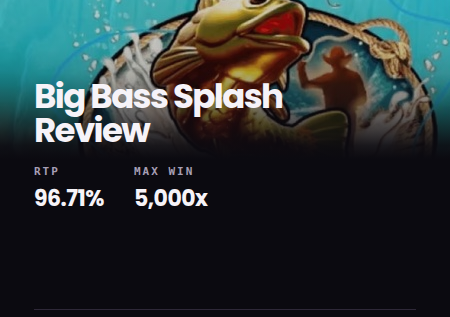

Big Bass Splash returns 96.71 percent in the game and 95.67 percent on Pragmatic Play’s own demo site. Here is which figure binds and what the gap costs you.
Big Bass Splash returns 96.71 percent according to the game itself, and 95.67 percent according to the studio’s own demo site. Both numbers carry Pragmatic Play‘s name. I score it 6 out of 10.
This is the third game in Pragmatic’s fishing series, released in June 2022, on five reels and three rows with ten paylines. Fish symbols carry cash values, the fisherman wild collects every value on the screen, and the whole game is built around reaching the free spins round where he appears.
I opened the demo on this site on 22 October 2026 and read all seven rules pages. Then I read the studio’s game page and the studio’s demo site. Three sources, two different returns, and that gap is the most useful thing on this page.
Every figure below was read from one of three places, and the column on the right says which. Where two sources disagree, both are printed.
| Figure | What it says | Where I read it |
|---|---|---|
| Return to player | 96.71% | Rules screen inside the game, page 4 of 7 |
| Return on the studio demo site | 95.67% | Pragmatic Play’s own demo site |
| Return when buying free spins | 96.71% | Same rules screen |
| Volatility | Medium, with the studio’s own definition printed beside it | Rules screen and the studio demo site agree |
| Hit frequency | 13.66% | Studio demo site, nowhere inside the game |
| Maximum win | 5,000x the bet, a hard cap | Rules pages 3 and 6 |
| Bonus buy | 100x the current total bet | Rules page 3, and the button itself |
| Stake range | 0.10 minimum, 250.00 maximum | Rules page 4 |
| Grid and lines | Five reels, three rows, ten paylines | Rules page 4 |
| Released | 23 June 2022 | Studio demo site |
| Odds of the 5,000x cap | Not published anywhere | Checked all three sources |
| How often the feature lands | Not published anywhere | Checked all three sources |
The last two rows are the ones that decide a score on this site. A game can publish a generous headline return and still tell you nothing about how far away the part you are paying for sits.
I score a slot on four criteria. Where a studio publishes nothing a criterion can be built from, I leave that criterion unscored, say so here, and average the ones that remain.
| Criterion | Score | Why |
|---|---|---|
| Return to player | 9 | 96.71 percent is the figure the game prints and the figure you are playing. That sits in the 96.50 to 96.99 band. The 95.67 on the studio demo site is a flag, not the figure the rules screen gave me |
| Cost of reaching the feature | 6 | The buy costs 100x the total bet, which is the bottom of the 100x to 199x band. Ten euros at the minimum stake, and a hundred ordinary spins otherwise |
| Volatility honesty | 4 | One of the three figures is published, the 13.66 percent hit frequency. The feature frequency and the odds of the cap are missing, and the published hit frequency argues with the volatility label |
| Session survivability | Not scored | The band needs a published feature frequency. Nobody publishes one for this game, so I will not invent a spin count and dress it up as measurement |
| Overall | 6 / 10 | Nine, six and four, averaged and rounded |
The full method, with every band written out, sits on the rating method page. A six here means a good return attached to a feature nobody will tell you the distance to.
Open the information screen inside the game and page four tells you plainly that the theoretical return is 96.71 percent. The same page repeats it for the bonus buy. Pragmatic Play’s main game page prints 96.71 percent as well.
Then open the studio’s own demo site, the one Pragmatic runs to show its games to operators and players, and the information panel for this exact title prints 95.67 percent.
That is a gap of 1.04 percentage points between two pages owned by the same company. I read the lower figure twice to be sure it was not a transposition of the higher one. It is not.
| Source | Return printed | What it would score |
|---|---|---|
| The game’s own rules screen | 96.71% | 9 out of 10 |
| Pragmatic Play’s game page | 96.71% | 9 out of 10 |
| Pragmatic Play’s demo site | 95.67% | 6 out of 10 |
Two of the three agree, so I scored the figure the game gave me. If your casino’s rules screen prints the lower number, trust the screen in front of you and not this page.
Here is why this is worth more than a footnote. Pragmatic licenses several of its titles at more than one return, and the casino chooses which build to install. A second figure published by the studio itself is the strongest hint you will get that a lower build of this game exists somewhere.
What does the gap cost? Over a thousand euros of turnover, 1.04 percentage points is ten euros and forty cents. That is small on one session and it is the difference between a good game and an ordinary one over a year.
The habit worth building is simple. Open the information screen before your first spin and read the return your casino actually installed. It takes ten seconds and it is the only number that binds.
The loading screen and the rules both carry a medium volatility badge. The studio prints its own definition next to it: medium volatility games pay out steadily, and the range of pays varies from low to very high.
Now put the published hit frequency beside that sentence. At 13.66 percent, something lands on roughly one spin in seven. Six spins out of seven return nothing at all.
| Game | Volatility label | Published hit frequency | One win every |
|---|---|---|---|
| Big Bass Splash | Medium | 13.66% | 7.3 spins |
| Big Bass Bonanza | Low | 13.00% | 7.7 spins |
| Gates of Olympus 1000 | High | 28.41% | 3.5 spins |
Read the middle row and then the top one. The studio calls the quieter of the two fishing games low and the busier one medium, and the two hit frequencies are separated by two thirds of one percentage point. The labels are doing work the numbers do not support.
I am not calling the label dishonest. I am saying it is doing nothing for you. A word that moves from low to medium while the measured number barely moves is decoration, and the number underneath it is the thing to read.
One more thing the hit frequency does not tell you. It counts any win, including the ones smaller than your stake. A game can pay something on one spin in seven and still take your balance down steadily, because paying something is not the same as paying more than you put in.
Fish symbols carry cash values printed as a multiple of your total bet. The rules list every value they can take, which is more than most games will tell you.
| Where the value sits | What a fish can be worth |
|---|---|
| Ordinary | 2x, 5x, 10x, 15x, 20x, 25x |
| Good | 50x, 100x, 200x |
| Rare | 500x, 1,666x |
| The two that end the round | 2,500x and 5,000x |
Thirteen fixed values, read from page two of the rules. Nobody publishes how often each one lands, which is the figure that would turn this list into a probability.
Look at the bottom row again next to the cap. The maximum win is 5,000x the bet, and the largest single fish is worth 5,000x the bet. One symbol, collected once, reaches the ceiling of the whole game.
The rules are blunt about what happens then. If the total win of a free spins round reaches 5,000x the bet, the round immediately ends, the win is awarded, and all remaining free spins are forfeited.
Forfeited, not banked and continued. If you are four spins into a twenty spin round when the counter hits the ceiling, the other sixteen stop existing. That is standard across the industry and it is still worth knowing before you watch it happen.
It also quietly limits the multiplier ladder. The feature can raise your collections by up to ten times, but the cap does not move, so the ladder reaches the ceiling faster rather than lifting it.
The fisherman is the wild, and in this game he only shows up during free spins. Every wild that lands collects the value of every money symbol on the screen, and the collecting continues until the round ends.
Every fourth wild does something extra. It retriggers the feature, adds ten more free spins, and moves the collection multiplier up a level.
| Level | Reached by | Multiplier on collections | Extra spins |
|---|---|---|---|
| One | Triggering the round | None | 10, 15 or 20 |
| Two | The 4th wild | 2x | 10 |
| Three | The 8th wild | 3x | 10 |
| Four | The 12th wild | 10x | 10 |
| Five | Does not exist | The feature cannot be retriggered after level four | None |
Read from pages two and three of the rules. The jump from 3x to 10x is where the game’s whole reputation comes from, and it needs twelve wilds inside one round to get there.
Before the round starts, the game randomly picks between zero and five modifiers that apply to it. This is the part of Big Bass Splash that is genuinely new in the series, and it is also the part with no published odds at all.
| Modifier | What it does |
|---|---|
| More Fish | More money symbols sit on the reel strips for that round |
| More Fisherman | More wilds sit on the reel strips, which is the one that moves you up the levels |
| More Dynamites, Hooks and Bazookas | Raises the chance of the three random in-round features |
| Start From Level 2 | The round opens on the 2x multiplier instead of none |
| Plus 2 Spins | Two more spins at the start and two more on every retrigger |
Zero to five of these are selected at random before you see the first reel of the round. How often you get none, and how often you get all five, is not published by anyone.
Three more things can happen inside the round at random. Dynamite drops money symbols into empty positions when there are fishermen but no fish. A hook pulls a reel upward to bring fishermen onto the screen when there are fish but no fishermen. A bazooka changes every symbol except the fishermen into something else.
In the base game there is one more helping hand. When two scatters land without a third, the reels carrying them can move down one position and respin, or a hook can pull a reel up to reveal the third. Neither is guaranteed and neither is quantified.
The original sits in the same lobbies and scores two points higher here. Side by side, the differences are smaller than the artwork suggests and they all push the same way.
| What changes | Big Bass Bonanza | Big Bass Splash |
|---|---|---|
| Released | December 2020 | June 2022 |
| Return, in the game | 96.71% | 96.71% |
| Return, on the studio demo site | 96.71% | 95.67% |
| Hit frequency | 13.00% | 13.66% |
| Volatility label | Low | Medium |
| Maximum win | 2,100x | 5,000x |
| Top multiplier in the feature | 10x | 10x |
| Bonus buy | None at all | 100x the total bet |
| Stake range | 0.10 to 250.00 | 0.10 to 250.00 |
| My score | 8 / 10 | 6 / 10 |
Two rows carry the whole two point difference. The original has no buy button, which scores a ten, and the original publishes one return instead of two.
That is worth saying plainly, because it runs against what the marketing implies. The sequel more than doubles the ceiling and adds a feature nobody else in the series has, and it still scores lower.
It scores lower because my method does not reward a bigger ceiling. It rewards a studio that publishes what it knows and a game that does not charge you to reach its own feature. On both counts the older game does better.
If you prefer the newer one, nothing here says you are wrong. The returns are identical in the game, the modifiers make a round less repetitive, and you are paying for the bigger ceiling with a buy button you can simply refuse to press.
The free spins round can be bought from the base game for 100 times your current total bet. On the triggering spin the game randomly drops three, four or five scatters, so the buy does not guarantee the twenty spin version.
In the demo at a two dollar bet, the button read exactly 200 dollars. At the 0.10 minimum a round costs ten euros.
Credit where it is due on one point. The rules print the return for the bought round as well, 96.71 percent, the same as ordinary play. Most studios never publish that figure at all, and some of the ones that do publish a lower number for the buy.
| Game | Buy price | Return on the buy | Score |
|---|---|---|---|
| Big Bass Bonanza | No buy at all | Not applicable | 10 |
| Big Bass Splash | 100x the total bet | 96.71%, published | 6 |
| Gates of Olympus 1000 | 100x the base bet | 96.49%, published | 6 |
| Sugar Rush | 100x the base bet | 96.50%, published | 6 |
The band measures the price, not the manners. Publishing the buy return is the right thing to do and it does not change what a hundred spins converted into one round costs you.
There is no ante bet in this game, so the buy is the only shortcut on offer. You either pay the hundred or you wait, and nobody will tell you how long the waiting usually takes.
The stake range runs from 0.10 to 250.00, and the studio’s demo site agrees with the game on both ends. At the minimum, fifty euros is a real session rather than a handful of spins.
| What fifty euros is | At the 0.10 minimum |
|---|---|
| Ordinary spins | 500 spins |
| Spins that return something, at 13.66 percent | About 68 of those 500 |
| Spins that return nothing | About 432 of those 500 |
| Bought feature rounds, at 100x | Five rounds, and nothing left over |
My arithmetic from the published figures, not the studio’s. The row that is missing is how many of those 500 spins would reach the feature on their own, because no source publishes a feature frequency for this game.
That missing row is the reason this game scores a six rather than an eight. I can tell you what a session costs and roughly how often a spin pays something. I cannot tell you how long you would wait for the round the whole game is built around.
Notice the third row as well. Four hundred and thirty two spins out of five hundred return nothing, and that is the experience the word medium is covering for.
The game is the same everywhere. The terms wrapped around it are not, and that is where a session quietly gets more expensive. Four things are worth thirty seconds each.
First, the return printed in the game information panel, every time you open the game at a casino you have not used before. Plenty of slots ship in more than one build, and that panel is the only place the figure you are actually playing is shown.
Second, how the game counts toward wagering, and whether buying a feature voids an active bonus. Slots usually count in full, but feature purchases are excluded under most terms and some casinos cancel the bonus outright for one. The wagering terms are where both of those live.
Third, the maximum stake allowed while a bonus is running. It is commonly five euros a spin, and going over it once is enough for a casino to void everything the bonus produced.
Fourth, the cap on what you may withdraw from bonus winnings. A large maximum win means nothing if the terms stop your payout well below it, and that ceiling is printed in the bonus terms rather than in the game.
The return figure on its own tells you nothing about what a session costs. What costs you money is the return multiplied by how much you push across the table, and a slot pushes a great deal. Six hundred spins in an hour is an ordinary pace once autoplay is running.
At 96.71 percent the house keeps 3.29 percent of everything staked. Here is what that is worth at three ordinary stakes, using the same model as my cost per hour table.
| Stake per spin | Wagered in an hour | House edge | Cost of the hour |
|---|---|---|---|
| €0.20 | €120 | 3.29% | €3.95 |
| €0.50 | €300 | 3.29% | €9.87 |
| €1.00 | €600 | 3.29% | €19.74 |
Six hundred spins an hour, the house edge applied to everything wagered in that hour. These are averages over a very long run, not a prediction for one session, and the swings in either direction are far larger than the edge.
The demo on this site runs the same build as the real money game, on a play money balance that resets when you reload. No account and no deposit. It is also where I read every figure above, and you can check all of them yourself.
If you want to compare the two fishing games back to back, the original demo runs here as well, and the review of it carries the same figures read the same way.
Pragmatic Play sits in the supplier list of most casinos I have reviewed, so this game is one of the easier ones to find. What varies is who holds your money afterwards, and that is the part worth choosing on.
The columns below are the two that matter for a game review. Game selection tells you how likely the title is to be there at all, and payouts and support tells you what happens when you win.
| Casino | Score | Game selection | Payouts and support | Full review |
|---|---|---|---|---|
| Playfina Casino | 7 / 10 | 8 / 10 | 8 / 10 | Read the review |
| National Casino | 7 / 10 | 9 / 10 | 8 / 10 | Read the review |
| HellSpin Casino | 7 / 10 | 9 / 10 | 8 / 10 | Read the review |
| 22Casino | 7 / 10 | 9 / 10 | 8 / 10 | Read the review |
| CasinoChan | 7 / 10 | 9 / 10 | 7 / 10 | Read the review |
Every casino score is the average of four criteria, rounded, and the working sits inside each review. Game selection alone is not a reason to pick one, which is why the terms and the bonus columns live in those reviews rather than here.
Playfina and National are level at the top before rounding. They match on terms fairness and on payouts, and bonus value separates them, seven against six, so Playfina takes the recommendation.
Carry one habit in with you, and it is specific to this game. The rules screen inside your casino’s copy is where the return you are actually playing appears. If it reads 95.67 percent rather than 96.71, you have found the lower build, and this page would rather you knew.
What is the RTP of Big Bass Splash?
The rules screen inside the game prints 96.71 percent, and Pragmatic Play’s own game page prints the same figure. The studio’s separate demo site prints 95.67 percent for the same title, so check the screen in your casino before you stake.
Why do two Pragmatic Play pages show different returns?
Pragmatic licenses several of its games at more than one return and lets the casino choose the build. A second figure published by the studio itself is the strongest signal that a lower build of this game exists somewhere in the market.
What is the maximum win in Big Bass Splash?
5,000 times your bet, and it works as a hard cap. The rules say that when a free spins round reaches it the round ends immediately, the win is awarded, and every remaining free spin is forfeited.
How much does the Big Bass Splash bonus buy cost?
One hundred times your current total bet, which is ten euros at the 0.10 minimum. The buy drops three, four or five scatters at random, so it does not guarantee the twenty spin version of the round.
Is Big Bass Splash high volatility?
The game calls itself medium volatility and prints the studio’s definition beside the badge. The published hit frequency of 13.66 percent means something lands on about one spin in seven, which is quieter than the word medium suggests.
How many free spins do you get?
Three scatters award 10 free spins, four award 15, and five award 20. Every fourth fisherman wild inside the round adds another ten spins, up to a maximum of three retriggers.
What are the modifiers in Big Bass Splash?
Between zero and five are picked at random before each free spins round: more fish, more fishermen, a higher chance of the dynamite, hook and bazooka features, a start on the 2x level, and two extra spins on the round and on every retrigger.
How do the four levels work?
Every fourth wild moves the round up a level and adds ten spins. Level two multiplies collected money symbols by 2x, level three by 3x and level four by 10x, and after level four the feature cannot be retriggered again.
What is the difference between Big Bass Splash and Big Bass Bonanza?
Both print 96.71 percent inside the game. Splash more than doubles the cap to 5,000x, adds the modifiers and adds a bonus buy at 100x, while Bonanza caps at 2,100x and has no buy button at all.
Why does this game score 6 out of 10?
The return earns nine and the 100x buy price earns six. Volatility honesty scores four, because only the hit frequency is published while the feature frequency and the odds of the cap are missing, and session survivability cannot be scored at all.

I came to this from finance, which is probably why I read a casino the way I read a contract. The marketing sits on the homepage, and the clause that decides whether you get paid sits twelve pages down.
I am responsible for everything published here, including the gaps. I opened this game on 22 October 2026 and read the return, the stake range, the cap clause and the full money symbol ladder from its own seven rules pages. Where the studio’s two websites disagree about the return, I have printed both figures and said which one the game gave me rather than picking the tidier one. If you find a casino running this title at 95.67 percent, send me the screenshot and I will add it to this page with the date.
18+. Gambling can be addictive. A 96.71 percent return is a long run average across millions of spins and it describes no single session, including yours. A published hit frequency of 13.66 percent means most spins return nothing, whatever the word on the badge says. If gambling has stopped being entertainment, free and confidential help is available in Slovenia through NIJZ.